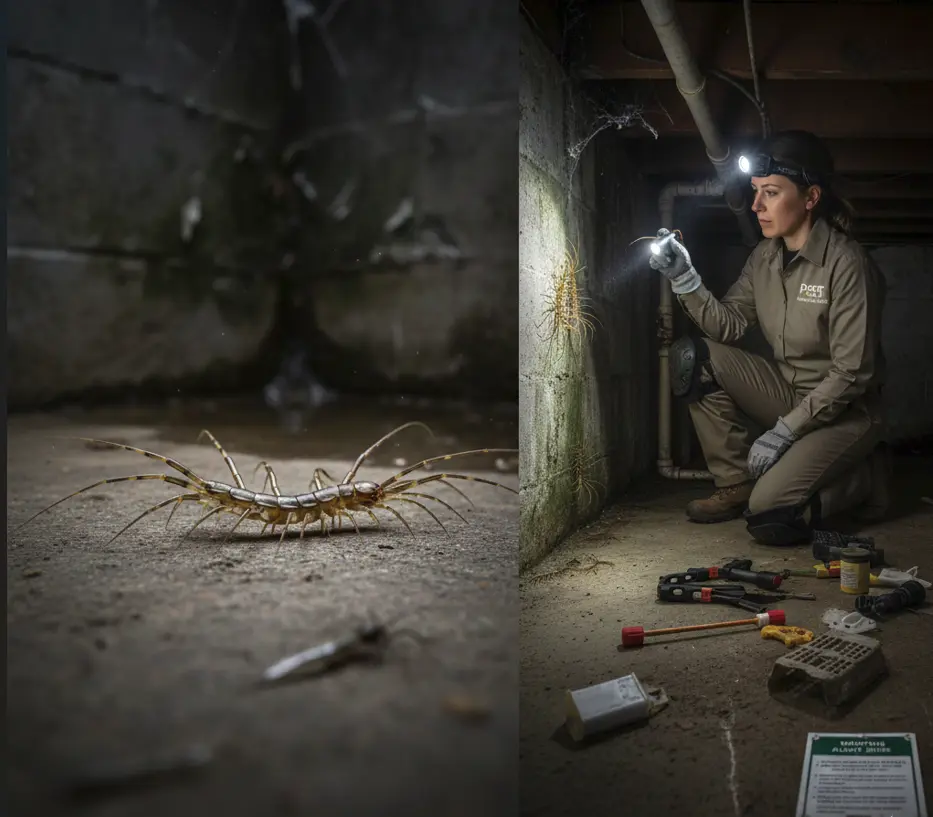
What Are House Centipedes?
House centipedes are elongated, fast-moving arthropods with up to 15 pairs of long, delicate legs. Despite their insect-like appearance, they are not insects at all. They belong to the class Chilopoda, a group of predatory arthropods that have existed for millions of years. Their pale yellow or gray bodies, combined with their sudden bursts of speed, often make them one of the most unsettling pests for homeowners in Columbus.
House centipedes are primarily nocturnal. During the day, they hide in dark, damp places such as wall voids, crawl spaces, basements, floor drains, and under appliances. At night, they emerge to hunt, which is why many people only notice them when they suddenly dart across the floor after the lights are turned on.
Why Centipedes Enter Homes
Centipedes do not randomly wander indoors. They are drawn to very specific conditions that many homes in Columbus unknowingly provide. The two biggest attractants are moisture and food.
Leaky pipes, condensation around HVAC systems, damp basements, poor ventilation, and high indoor humidity all create ideal environments for centipedes to survive and reproduce. In addition, centipedes are predators. They feed on spiders, ants, cockroaches, silverfish, and other small insects. When these pests are present, centipedes will follow.
In many cases, a centipede infestation is a symptom of a larger underlying pest or moisture problem. This is why simply killing the centipedes you see rarely solves the issue long-term. Professional inspections often reveal hidden water sources or insect activity that homeowners were unaware of. You can read more about how underlying pest problems develop in our guide Bug Bites: When to Worry and When to Call Pest Control .
Do Centipedes Bite?
One of the most common questions homeowners ask is whether house centipedes bite. The answer is yes, but it is extremely rare. House centipedes are shy and avoid human contact whenever possible. They do not seek out people or pets and will usually flee rather than defend themselves.
Bites typically only occur if a centipede is trapped against the skin or handled directly. When a bite does happen, it is usually mild and comparable to a bee sting, causing temporary redness, minor swelling, or brief discomfort. Serious reactions are uncommon. Unlike some other pests, house centipedes are not known to transmit diseases to humans.
Are House Centipedes Dangerous?
While their appearance can be alarming, house centipedes are not considered dangerous. In fact, some pest professionals refer to them as accidental allies because they prey on more problematic pests like cockroaches. However, that does not mean they should be ignored.
Seeing centipedes indoors often indicates excess moisture, poor ventilation, or an active insect population. Left unaddressed, these conditions can lead to mold growth, structural moisture damage, and more serious pest infestations. For homeowners in Columbus, centipedes should be viewed as an early warning sign rather than a harmless curiosity.
How to Get Rid of House Centipedes
Effective centipede control focuses on eliminating the conditions that allow them to thrive. This includes reducing indoor humidity, fixing leaks, improving ventilation, and sealing cracks and gaps where pests enter. Targeted treatments in cracks, crevices, and damp areas help eliminate hiding spots and prevent future activity.
DIY methods like sticky traps or store-bought sprays may reduce sightings temporarily, but they rarely address the root cause. Professional pest control takes a more comprehensive approach by identifying moisture sources, treating hidden areas, and reducing the insects centipedes feed on. According to The Spruce guide on centipede control , long-term prevention is far more effective than repeated spot treatments.
When to Call Professional Pest Control in Columbus
If centipedes keep appearing despite cleaning and basic prevention efforts, it is time for a professional inspection. Recurring sightings usually mean the problem is deeper than what is visible on the surface. Licensed pest control professionals can locate moisture issues, identify entry points, and apply targeted treatments that stop centipede infestations at the source.
If you are seeing centipedes along with other pests, or if they are concentrated in specific areas like basements or bathrooms, professional pest control services in Columbus can provide a long-term solution that restores comfort and peace of mind.